06. May 2020 · Comments Off on Avoiding Scottish economic collapse after 2026 · Categories: AGR
The 18 year land cycle is real.
The next bust will erupt after house prices peak in 2026. Even Covid-19’s disruptions are not sufficient to delay the inevitable. Only world wars have in the past disturbed the cycle.
Speculators use this insider knowledge to extract ground rent that belongs in the public purse.
Yes, you can use the cycle to get rich. But at the cost of inevitable eventual mass destitution of human beings.
SLRG is saying that we can and must END land speculation (with AGR replacing existing taxes) if devastating carnage is to be avoided in Scotland in 2028.
Investment in the enterprises that actually produce the wealth would be the result of moving taxes off wages and trade and on to the unearned rent of land and all natural resources.
Society would not then be threatened with collapse in 2028.
01. May 2020 · Comments Off on Why are MMT proponents on the wrong bandwagon? · Categories: AGR
Because were the optimum and fair public revenue stream being collected, there would be no requirement for schemes to help governments struggling with deficits.
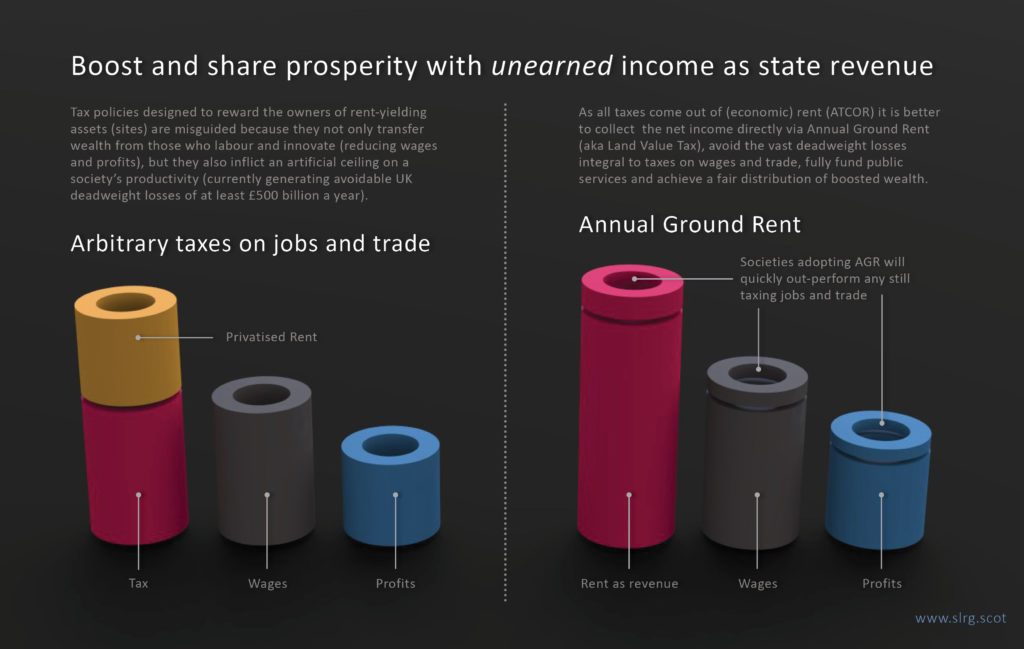
Economists Professor Roger Sandilands and Fred Harrison point out that Economic Rent (often disguised as interest/profit) accounts for about half the UK gross income.
Current taxes collect about one third. And non-contributing parasites extract one fifth (the yellow zone in our diagram).
This net income is the rent of land and natural resources which Adam Smith and the classical economists said was the optimum source of state revenue.
Collecting this stream of wealth would be both fair and efficient: At least £500 billion a year of UK deadweight losses (Scotland at least £38bn) would be avoided. This is the lower estimate of the production absent in the UK each year for as long as we continue to tax wages and trade.
As we can see from the diagram, the public purse would double in a very short time.
Apart from the obvious implications for public service funding and embedded UK inequality, the Westminster and Scottish governments would no longer require any scheme devised to help governments in deficit. Nor would the citizens of any country making the change require such schemes; all their needs would be met out of the collected funds they all help collectively to produce.
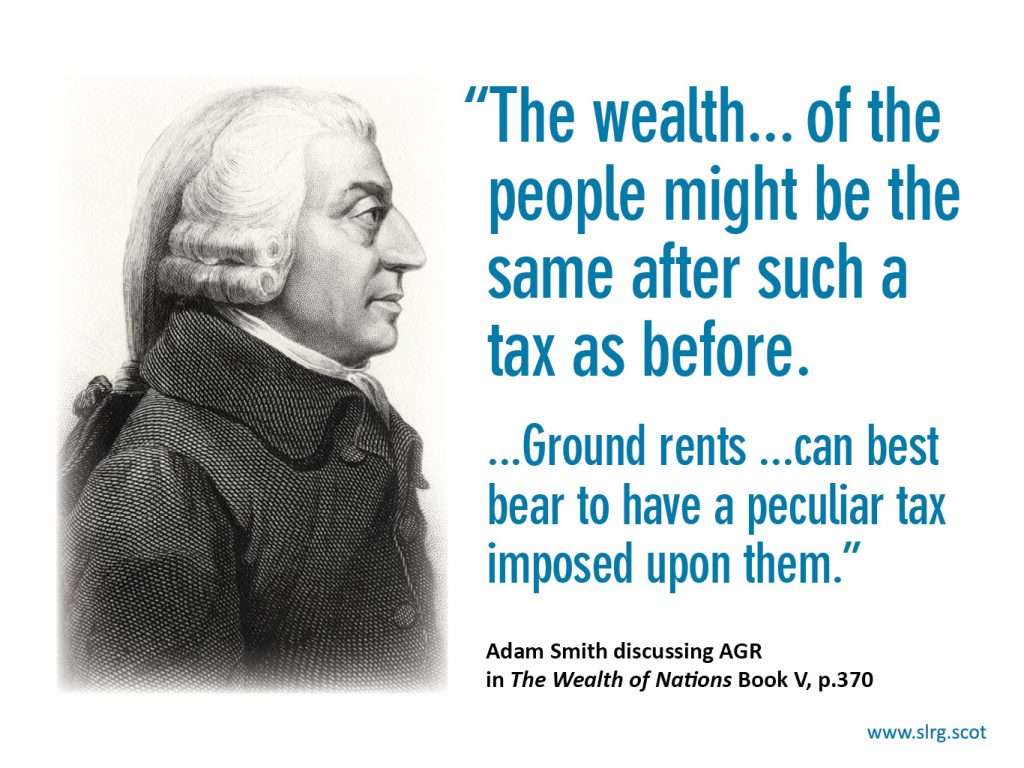
Rather, as Adam Smith pointed out, were the rents of land and natural resources to again be directed back to the community that generated them, they might be as well of after the levy as before.
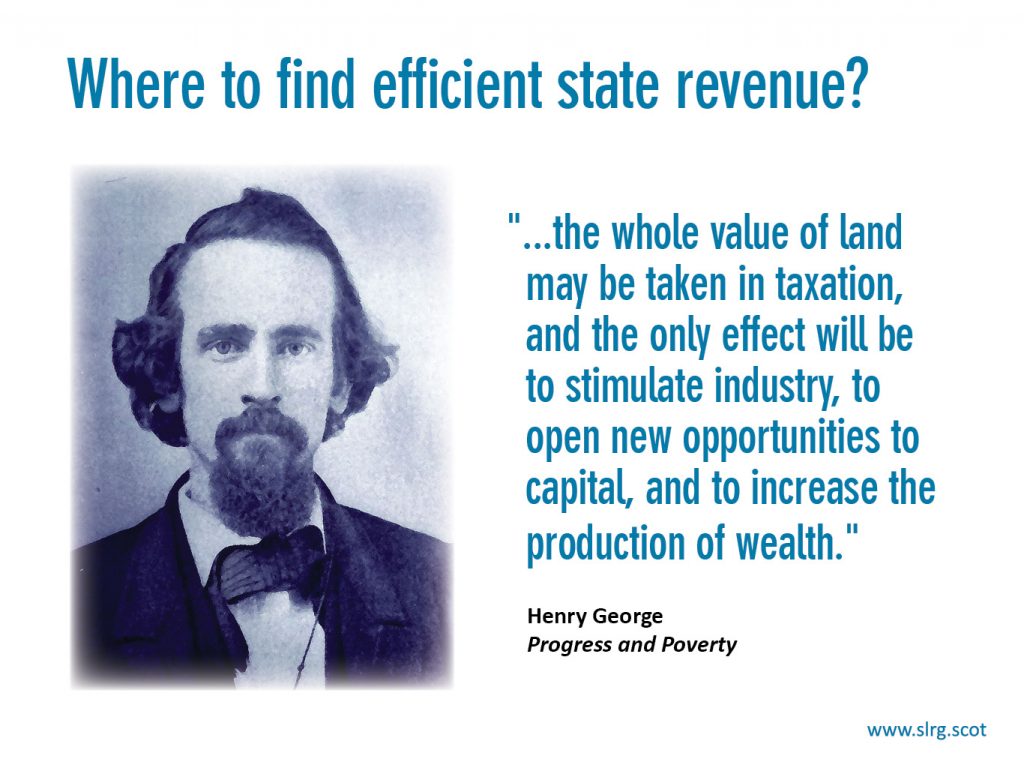
What then for industry, investment and today’s fragile communities? Let Henry George himself answer:
01. May 2020 · Comments Off on Preparing for the next pandemic · Categories: AGR
South Korea 20,000+ tests/day at the start Scotland 1,370 tests/day at the peak
A country taking the threat of a pandemic seriously might have prepared for one. Like South Korea did after MERS.
Scotland and the UK were unprepared. The projected outcome? 100 times as many Scottish deaths (per capita) and vastly multiplied economic damage.
In the future it may be that money will be found to take the necessary precautions. But there is no doubt that starving public services in Scotland ensured proper precautions against a pandemic could not hitherto be funded despite the warnings of epidemiologists.
‘Maybe it will never happen’ proved to be wishful thinking on the part of our politicians.
Which is why Scotland needs to move immediately to AGR/LVT as state revenue. One of the numerous positive outcomes for Scots would be to find the contents of their public purse doubling in short order. After which any and all precautions against pandemics will be easily affordable …not to mention the rest of Scotland’s currently enfeebled publicly funded services.
30. April 2020 · Comments Off on Two Britneys, Professor? · Categories: AGR
A chat with Roger Sandilands, Emeritus Professor of Economics, Strathclyde, with a final comment by economist and author Fred Harrison.
SLRG: We describe economic rent as the rent of land and natural resources. This Economics educator tells us economic rent is something Britney Spears gets. https://www.youtube.com/watch?v=0MyRtCG9WS4 Who is right?
Is economic rent something Britney Spears gets (or indeed her predecessor of the 1880s, Britney Speirs)?
Professor Sandilands: The vertical supply curve for Britney Spears is analogous to the fixed supply of Land (including natural resources). When considering a vertical supply curve for fixed Land, this is the normal concept of (land) rent. (And it’s not to be confused with the “rent” I pay when I rent someone’s house or shop or factory. Some of that is rent, the rest is payment for man-made capital and other services.)
Just to confuse us, there are two Britneys.
First there was Britney Speirs. The famous economist Alfred Marshall (who died in 1924 but knew Britney well from Cambridge music halls) referred to her exceptionally high earnings (compared to your average Jo) as “quasi-rent”.
Did she, or does Britney Spears deserve this quasi-rent? Certainly they do if they had to spend years training their voices and working all hours of the day and night to capitalise on their popularity and talent.
But what if they were born with this exceptional – even unique – talent that no-one else can replicate despite thousands paying £50 each to hear them at concerts? Well (a) you could impose an 80% marginal rate of tax and expect them still to perform as much as before and/or (b) you could say, well at least the talent is theirs; it inheres in them and why should we tax them for it, especially if they would then decide to do fewer concerts, or move to a tax haven.
But LAND is different. The rent it (or its owners) can command in the market is a social surplus, and the payments are known as ‘transfer payments’, from renters to owners. Land is fixed in total and in its locations, whether it is used or not. It is therefore passive. The production is done by workers and entrepreneurs and they get paid according to supply and demand that fixes their wages and profits. After they get their makrket wages and profit (interest on use of man-made capital) the residual is what Land can get thanks to its relative scarcity and immobility. If wages and profits (on capital) are taxed the relative cost of labour and capital increases and the residual available to pay rent and/or buy land is reduced.
This is the ATCOR principle. And ATCOR works both ways. Cut taxes and rents increase, and these rents will be captured by land owners – or by government on behalf of us all, under AGR/LVT.) The exceptional income Britney gets is an individual rather than a social surplus; a personal “quasi-rent” that other individuals cannot fully compete away.
SLRG: Is the evolution of Marshall’s ‘quasi-rent’ into ‘economic rent’ by Neo-classical economists documented then Roger? If the story follows the pattern revealed in The Corruption of Economics, then there will have been some academic who saw a way to press the idea into serving the interests of rent-seekers by ‘developing’ it in some 1930s paper or book?
Professor Sandilands: I’m afraid that I can’t improve on The Corruption of Economics for the literature on the evolution of the classical to the neo-classical view of rent, and its baneful influence. However, Britney Speirs wrote a long lost, unpublished manuscript on the subject in 1897 that I found in my attic last week!
My beef with the Marshallian neo-classical marginalist revolution is that it introduced the ‘opportunity cost’ notion to undermine the notion that rent is a surplus over the zero labour cost of production of land qua land.
In classical (Smith, Ricardo) economics, the price or rent of land is what the market will bear for an asset that is fixed in supply and location. Demand interacts with the site’s fixed supply. The price is effectively a monopoly price because supply cannot be increased to drive down the price to the zero cost of production. In this it almost unique (Britney Speirs excepted). Contrast the supply of face masks, or ventilators.
The amenities surrounding a site (transport links, schools, shops, cinemas, stadia, etc etc) had huge labour costs over time, but not the site itself. Those amenities (plus natural features, such as load-bearing capacity, climate, gradient etc) determine its attractiveness to potential buyers or tenants. But the site itself has always been there and always will be, no matter what is put on it or how it is used. To repeat, rent in the classical labour theory of value, is a pure surplus over the zero labour cost of the site itself. [Labour costs are both the direct and indirect labour costs of the man-made capital involved.]
Now consider the neoclassical approach to rent as an opportunity-cost theory of value.
To illustrate, suppose the Duke of Westminster rents out a block on Oxford Street for development as a cinema (its best potential use) and it fetches an annual rent of £2m.
But, say the Marshallians, its next best use would have been as a department store and the highest rent potential would then have been, say £1.9m a year. So its “transfer earnings”, based on opportunity cost, is only £100k. Classical rent has been spirited away by 90%.
To the individual, rent is indeed a cost, and the neo-classical approach is relevant. But socially, rent is not a real cost. It is just a transfer payment. Its real cost is zero, but its demand is what the market will bear, given surrounding amenities or natural advantages.
Annual Ground Rent as state revenue please!
SLRG: Anything to add, Fred Harrison?
Fred Harrison: What you need to bear in mind is this. The original theorists did not want people to focus on “land” as a special category. So the way to remove the unique qualities of the services provided by nature was to argue as they do in that video – namely, that Pavarotti’s “wage” is set by the wage that can be commanded by the barber of Seville; and the sum above that level is “economic rent”. The logic: Pavarotti would sing for his living, anyway, even if he was only paid the wage of the singing barber…so the rest could be taxed away without inhibiting him from singing in the opera theatre!
It’s intellectual dishonesty/gymnastics designed to befuzzle folk, and distract away from the optimum strategy for raising revenue (AGR).
30. April 2020 · Comments Off on How do governments cause their own social problems? · Categories: AGR
Simple really. The long project by land owners to untax land and natural resources transforms these assets into financial instruments. Competing for control of these rent-yielding assets (land speculation) increases their price many times over.
But the wealth we see today in the land market is not produced within the ‘real estate’ sector. It is instead transferred out of people’s wages and legitimate profits. Those who actually produce the wealth by working and innovating end up being sucked dry.
Feel familiar?
The two-tier society thus engineered, whether by accident or design (site owner interests set against those of renters), is an unequal one. An unequal society produced by mis-governance!
The historic and continuing achievement of landlords is that free capital gains flow relentlessly into the coffers of the site owners (for doing nothing) OUT of the pockets of wealth producers. One unintended side effect is repressed UK production to the tune of £500bn+ a year [Harrison].
In Scotland today we witness renters rendered the effective slaves of parasite landlords. History shows that in such circumstances internal stresses build relentlessly over time to a point where societies implode.
Such is the course upon which Scotland and the UK are travelling today. Trouble looms for Scotland when the land market peaks in 2026 and collapses. But returning to funding the state from the rent of land and natural resources (Annual Ground Rent aka Land Value Tax) and untaxing wages and trade would replace the conflict with co-operation and the impending bust with stability.
Where will our two governments have taken Scotland by 2028?
SLRG’s director writes in The Times Thunderer column, 13 April 2020.
After the pandemic, the last thing we need is a return to ‘business as usual’. A new start – to fund rather than repress the renewal of the economy – requires a fundamental revision of the way government raises its revenue.
Current taxes suit the owners of UK sites. After all, property remains the best performing investment. But what we’ve created is a skewed fiscal environment in which those renting their homes or business premises receive no share in the unearned bonanza and the population is forced to tolerate starved public services, unsustainable private and government debt, suppressed enterprise, low wages, high rents and an abused environment.
There is a way to boost productivity that would sustainably fund the country’s emergence form the pandemic, and which offers all producers a fair share of the UK’s productive capacity. But it’s not Sir Keir Starmer’s proposal to fund recovery with a wealth tax. A wealth tax does not distinguish between earned and unearned income. We need policies that create jobs; not ones that reduce employment. That can only be achieved by replacing the tax policies that were conceived to privilege a minority.
The UK needs to collect and pool the rent of land and natural resources instead of taxing wages and enterprise. Scottish Land Revenue Group (SLRG) economists estimate that half the UK gross income is produced by everyone working in partnership, plus what is provided free by nature. This is the UK’s ‘net income’.
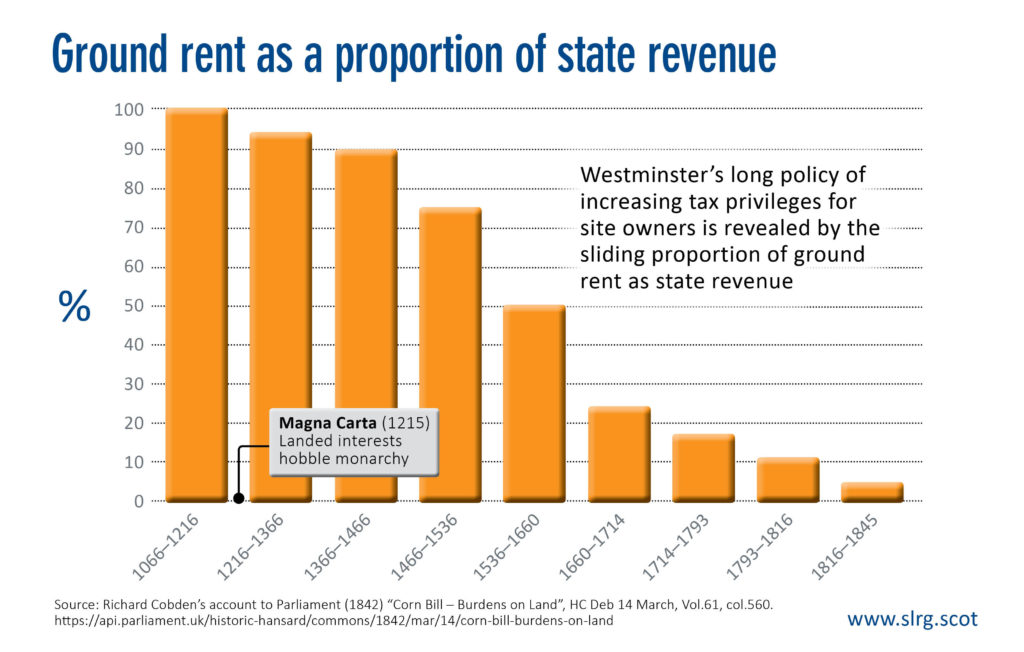
That net income should be the basis of government spending. But such was the historic ‘achievement’ of land owners that the proportion of state revenue collected from the land tax fell from 100% to 5% by the 1840s [R. Cobden, Hansard]. This obliged Parliament to shift taxes onto the people who produced wealth: employees and entrepreneurs. Result? Two centuries of repressed production, lost productivity and a host of associated crises ranging from starved public services to homelessness, social fragmentation and a ravaged environment. All placed in sharp relief by coronavirus.
The replacement revenue is Adam Smith’s Ground Rent. Choosing Annual Ground Rent (AGR, aka LVT) would ignite a new Scottish Enlightenment, release enterprises to produce a much larger shared surplus and end the land speculation at the root of so many of our troubles.
Holyrood must ask the right questions of its retained experts. One of them, Nobel Laureate economist Joseph Stiglitz, affirms: “…it is highly efficient to tax rents because such taxes don’t cause any distortions…A stiff tax on all such rents would not only reduce inequality but also reduce incentives to engage in the kind of rent-seeking activities that distort our economy and our democracy.” The Price of Inequality (2012).
08. April 2020 · Comments Off on Back to ‘business as usual’ after coronavirus? No thanks! · Categories: AGR
Scots need no longer accept the grinding ‘norm’ as inevitable. They can choose a proper new start: escape from starved public services, unsustainable private and government debt, homelessness, suppressed enterprise, low wages and an abused environment in headlong retreat. These, and Scotland’s strident and deeply embedded inequality need not be sustained. The root cause can be swiftly and surgically removed IF we choose to cut it out.
The country must engage in a national conversation about the strategy to ensure our explosive emergence from the epidemic. Have your say here, see our press release here and see our short booklet, New Start Scotland is up to us… outlining the way forward to a well funded future for our land.
Devolved powers allow MSPs to grow and share Scottish prosperity by implementing Annual Ground Rent to address public service cuts, homelessness, unemployment and embedded inequality.