19. December 2018 · Comments Off on A proper Christmas present please · Categories: AGR

Allowing land speculation is what makes homes unaffordable.

It’s a choice.

One much favoured by those keen to continue extracting socially produced wealth at the expense of those who do not own sites.

For Christ’s sake let’s get AGR/LVT up the political agenda in 2019.

16. December 2018 · Comments Off on AGR/LVT offers to add £100bn to Scottish GDP by 2030 · Categories: AGR

Even with limited devolved tax varying powers Holyrood could add £100bn to Scotland’s GDP by 2030.

Sadly, without reform we’ll be lucky to see an increase of £20bn.

AGR/LVT please.

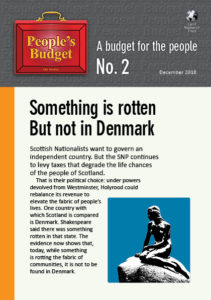
14. December 2018 · Comments Off on People’s Budget No. 2: The Scottish Budget · Categories: AGR

peoplesbudget2.web

The distortions affecting society and the economy from Wednesday’s Scottish budget are considerable and avoidable.

What is the public pricing mechanism that would render budgetary expenditures self-funding, so that the money does not have to be added to the tax burden of people working in Scotland?

In pursuing land reform, the Scottish government required The Scottish Land Commission to investigate the effectiveness of LVT around the world. Unfortunately the report by experts at the University of Reading is seriously flawed.

In People’s Budget No. 2 economist Fred Harrison explains why.

13. December 2018 · Comments Off on The DW Index: a replacement measure for GDP · Categories: AGR

Economist Fred Harrison and SLRG propose a better measure than GDP, which is rightly derided on all sides as a poor measuring tool for economic health.

09. December 2018 · Comments Off on SLRG’s Professor Roger Sandilands talks to Scottish Government economists on AGR/LVT · Categories: AGR

SLRG’s Professor Roger Sandilands’ presentation on AGR/LVT to Scottish Government employees on 19 October went well.

Here is Professor Sandilands’s 29-slide Powerpoint presentation. Edinburgh powerpoint presentation (r), Oct 2018

70 Scot Gov economists and other employees attended at the Victoria Quay building, with additional live streaming to two rooms in St Andrews House and a Glasgow venue.

It is hoped that the potential of AGR/LVT (economic rent as state revenue in place of taxes on wages and trade which repress wealth creation) to positively transform Scotland and share boosted prosperity, is now a little more widely understood.

Thanks to the event organisers, Spencer Thompson and Exploring Economics, an initiative in the Scottish Government aiming to promote a pluralistic approach to economics and to improve the understanding of economics among non-economists.

08. December 2018 · Comments Off on The Harrison Model · Categories: AGR

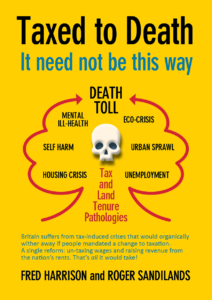
Are people killed being by misguided tax policies in 21st century Britain?

Explaining premature deaths by zone has been the subject of a lifetime of study by economist Fred Harrison www.sharetherents.org. For example, if you are a man living in Drumchapel you will die on average 17 years before men who live not far away in East Dunbartonshire.

Harrison’s economic model lays responsibility for the loss of up to an average 20 years of life, depending on where you happen to live, squarely at the feet of Government.

The cocktail of avoidable ill-effects of wrong tax policies is endured at higher levels by people living in marginal locations for the simple reason that arbitrary taxes cannot be afforded there. As a result they suffer disproportionately such effects as unemployment, the housing crisis, urban sprawl and figure disproportionately in the current self harm and mental ill-health epidemics. Harrison argues that the combined stresses of arbitrary taxation foment the horrifying and otherwise inexplicable statistics confronting us in daily news bulletins.

Yet the answer is a simple one. In Taxed to Death Fred Harrison and SLRG’s Professor Roger Sandilands explain the links and demonstrate how the benign and fair AGR tax reform would reverse each of these devastating trends and the annual death toll for which they are responsible.

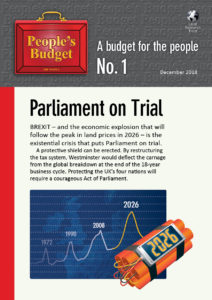
06. December 2018 · Comments Off on The People’s Budget No. 1 · Categories: AGR

The first of a new regular series of AGR commentaries from economist Fred Harrison of the Land Research Trust, designed by SLRG’s Ian Kirkwood, in which the interests of the peoples of the British Isles are at last placed centre stage.

When political power was devolved to Scotland, Wales and Northern Ireland,
the politicians in Westminster failed to re-base tax policies in ways that would equalise people’s life chances across the UK. The Brexit crisis provides the opportunity for regional authorities to renegotiate the fiscal settlement.

A new language that favours inclusive justice must replace the old concepts that were designed to divide and rule. The adversarial language was used by Scotland’s finance secretary Derek Mackay when he informed the Financial Times this week that he could impose higher tax rates on the “richest” people (but not yet). Words like rich and wealth are toxic tools that distort public policy. They disguise the streams of income that ought to be taxed.

Some people get rich by working hard: they add value to people’s well-being,
and they are rewarded accordingly.

Others get rich without adding to anyone’s well-being. This activity is pure rent-seeking, the legacy of an obsolete parliamentary politics.

Why treat these two groups as identical for revenue purposes?

Under the fiscal philosophy that prevails in Westminster, London and the South-east will always fare better than people in other regions. Now is the time for all representative institutions to engage in discussion on how to revise the flow of revenue into the public’s purses to achieve equitable outcomes across the four nations of the UK.


08. October 2018 · Comments Off on We need more enterprise and innovation; not less · Categories: AGR
Eaxctly how do its proponents think stacking more tax on enterprise and innovation would ease any of the manifold UK economic or social crises?
 
Of course it wouldn’t: what is required is more enterprise and innovation; not less.
 
Hammond’s proposed 2% tax on online sales will be passed to Amazon’s sellers and then deducted from UK wages. How can such a flawed financial recipe aid UK citizens facing Austerity?
 
It’s time to focus on how Annual Ground Rent/Land Value Tax would collect surplus production fairly from Tesco, Amazon and UK citizens to fully fund public services.
 
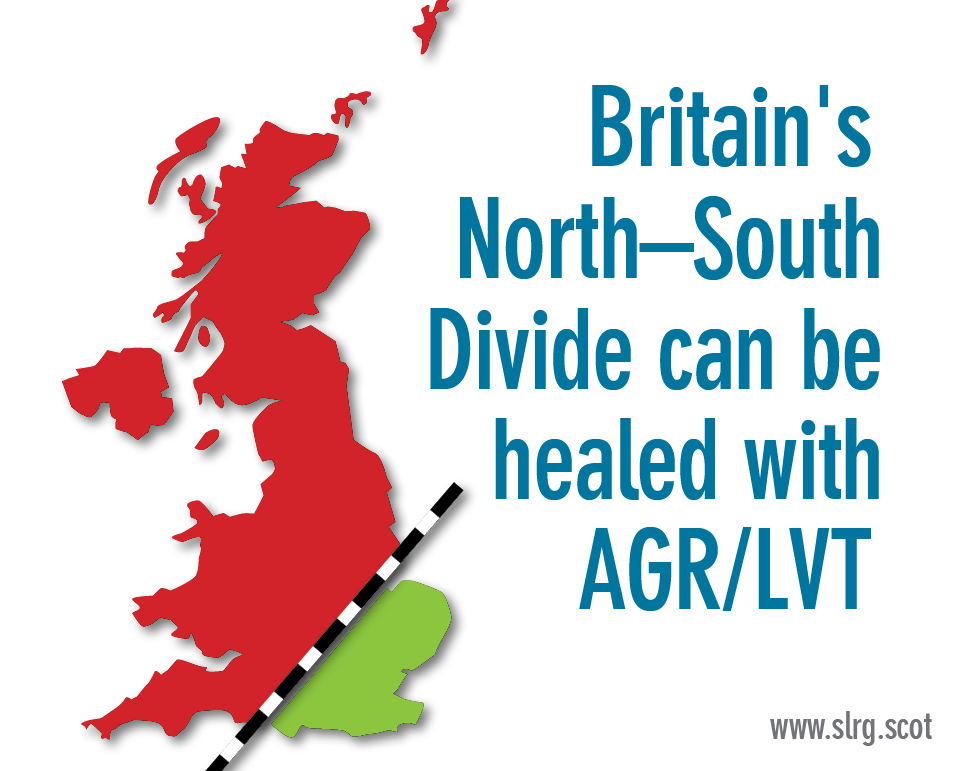
07. October 2018 · Comments Off on North-South Divide can be healed with AGR/LVT · Categories: AGR


Q. How would the North-South Divide be healed with Annual Ground Rent/Land Value Tax?

A. By collecting and distributing the returns (growing site values – biggest at the economic centre) on taxes invested in amenities by EVERYONE.

A proportional distribution of returns on taxes invested in amenities by the UK regions (including Scotland) would have made the UK Idea a union of equals. Prosperity produced by working together would have been shared.

Instead we have endemic and accelerating inequality: those socially-produced returns go to UK site owners, engendering a community of landlords fattened on unearned wealth (extracted from its producers).

Government failure to collect the AGR/LVT we all produce causes the rabid land speculation at the root of the housing crisis. Public services are starved whilst landlords celebrate. Renters of homes become their indentured servants for life. Communities at the margin decay: businesses there cannot afford the landlords’ replacement taxes on wages and trade. They are destroyed. Employment is gone and citizens there must die on average up to 20 years early.

AGR/LVT please!

05. October 2018 · Comments Off on Best chance since 1945 for a cross-party new start for the UK · Categories: AGR

In Brussels Blitz or £500bn Dividend Fred Harrison and Ian Kirkwood discuss how post-Brexit Britain could flourish as never before.

For 300 years the four nations of the United Kingdom laboured under a tax regime which imposed an artificial ceiling on ceiling on productivity. Those taxes continue to create havoc in people’s lives.

The only viable strategy for the UK is a fiscal reform-led programme that organically restructures the economy to replace rent-seeking with value-adding enterprise. This would re-balance relationships between the regions by eliminating the bias that now favours London. And it would transform the City of London to secure prosperity across the kingdom.

A national conversation is needed to create the democratic mandate that authorises the re-design of the public’s finances. And the leaders of all political parties must agree to work together to eliminate the internal barriers that rupture people’s health and wealth.
The annual damage caused by the tax regime amounts to at least £500bn. The palliative policies that are supposed to mitigate that damage have failed.

Twice in the 20th century the people of Britain mandated the structural reform of their finances. Twice the law was enacted. Twice, Parliament failed to honour the “rule of law”. Will Parliament now grasp the opportunity offered by Brexit to unite the nation in a new kind of prosperity?