05. October 2018 · Comments Off on SLRG talk to Scot Gov employees · Categories: AGR

Not long now till SLRG’s Professor Roger Sandilands addresses Scot Gov economists and employees (19 October) on Henry George and Annual Ground Rent/Land Value Tax.

It is the one subject we all need to get our heads around if we want something we certainly don’t have now: a boosted economy that shares prosperity.

Good luck Roger!

17. September 2018 · Comments Off on Investing after AGR cancels the returns from sites · Categories: AGR
SLRG’s Professor Roger Sandilands answers the question of how we’d be invited to invest in productive enterprise once unproductive land speculation is cancelled with AGR/LVT.
Share certificates pretty much as today?
 
Answer: Yes; why not? Investors’ prospective returns would
 
(a) be reduced by AGR and its consequential effect on the value of the firm’s “capital” (i.e., land) values.
 
(b) be enhanced, we must assume, by a corresponding (at least) reduction in corporate taxes and by the general boost to the economy as deadweight effects disappear.
 
It is vital that AGR replaces taxes rather than supplements them.
 
As taxes fall, so the underlying AGR would be revealed (the ATCOR principle). But the higher AGR would be its new market-clearing value, a value that would be voluntarily paid by those who successfully bid for space. Thereafter, the wealth they produce through their work and enterprise would no longer be penalised by the high marginal tax rates they currently bear.
 
In short, AGR, as a genuine fiscal revolution, would incentivise investment instead of penalising it.
Entrepreneurs can issue shares or borrow from banks, but investors in the new regime would do so to produce wealth rather than engage in Rent-seeking.
16. September 2018 · Comments Off on Don’t pay for sites up front · Categories: AGR

Imagine a Scotland in which buying ‘property’ meant you didn’t pay for the site up front.

Just for the building and for transferring the deed.

Instead you’d pay the annual rental value of the site to the state in place of current taxes on wages and trade (which repress enterprise and reduce Scotland’s wealth) and Council charges.

AGR/LVT

Scotland would simply be collecting the stream of wealth we all produce together. This social wealth is today allocated to site owners who receive it as unearned income for doing nothing. That the rest of us get none explains social dislocation and unequal life chances across Scotland.

Worse, the sum is over half the gross income of Scotland: its absence from the public purse explains our starved public services.

Thinking a little further, the range of site rental values from the economic centre to the periphery builds automatic progressivity into AGR/LVT, permitting life and work to exist again at the margin.

For those intent on addressing Scotland’s housing crisis, starved public services, land speculation and banking, personal and government debt, premature deaths by zone, depopulation, cyclical recessions and perpetual deficits, AGR/LVT is where to look for the solutions.

11. September 2018 · Comments Off on Is the Scottish Government a public body? · Categories: AGR

Scot Gov, one of the 50 actions you promised in 2016 was to “place a new duty on public bodies to consider the impact their decisions could have on poverty and disadvantage.”

Scot Gov, are you a public body?

If so, why are you choosing to persist with Income Tax, inflicting deadweight losses on Scots to the tune of at least £12bn a year, when there is an alternative source of revenue (AGR/LVT) which inflicts none?

You are choosing to sustain and increase AVOIDABLE poverty and disadvantage for Scots in blatant disregard of the fine words penned in your Fairer Scotland Action Plan.

https://www.gov.scot/FairerScotland

26. August 2018 · Comments Off on Radical Tax Reform: the answer to tax evasion, budget deficits and welfare cuts · Categories: AGR

SLRG publication by Duncan Pickard in which he discusses the favourable economic and social outcomes of adopting a radically different state revenue structure: AGR/LVT.

View or download the publication here: Radical Tax Reform.web

23. August 2018 · Comments Off on Calculating AGR/LVT charges when Council Tax and Income Tax are replaced · Categories: AGR
By SLRG’s Duncan Pickard
 

In the current tax regime land is permitted by society to be a private investment. Collecting AGR/LVT would partially or completely end this practice, which inflates land values far beyond their actual annual rental value (the amount someone would pay each year to monopolize a site’s natural and socially provided amenities.

When looking at the likely AGR liabilities it is therefore necessary to bear in mind that current site values are not a good guide. For example, prime farms today sell for about five times their productive value because governments choose to make them attractive investments with various tax breaks and access to subsidies.

This means that a proposed 1% AGR/LVT levy on prime agricultural land would not be £80 per acre (1% of today’s £8,000/acre) but £16 (1% of £1,600). A fundamental difference. And one which should also be borne in mind when predicting AGR liabilities for the owners of residential and urban sites.

‘Economic Rent’ is the surplus wealth of a country which remains after the costs of labour and capital have been met. Most of it is pocketed as unearned income by those who own land.

Because the government does not collect the economic rental surplus to pay for its necessary functions, it has to tax peoples’ earnings. This is detrimental to employment and trade. The collection of AGR by the government would have no detrimental effects on employment and trade but would instead encourage them by optimising the use of land.
The rental value of land is less variable than its market price which is influenced today by government interference, such as ‘help to buy’ schemes. The annual rental value of land is likely to remain constant unless it is increased by adjacent favourable developments or decreased by detrimental ones.
 
The market price of land is a useful guide to assess annual rental values because more data are available; but as the rental market for urban land increases adjustments can be made.
 
The annual rent of agricultural land with long term secure tenancies, for example, has traditionally been 5% of its market price (and the market price is 20 time its annual rent). But the current market price of agricultural land is almost 100 times its average annual rent because speculators, such as James Dyson, are buying land for the tax advantages.
 
‘Slipper farmers’ bid up farm prices, in turn attracting others to buy, resulting in the currently grossly inflated prices. The market price of urban land is similarly inflated by the favourable taxation of those who own landed property, especially that which is unused.
 
So whilst site values are a guide to the annual rental value which AGR/LVT would collect, the economic rental value of a site is its value above that of sites with no rental value because of their location rendering them capable only of providing subsistence: there is no surplus to provide rent after the costs of labour and capital have been met. The positive implications for the tax liabilities of peripheral communities is obvious.
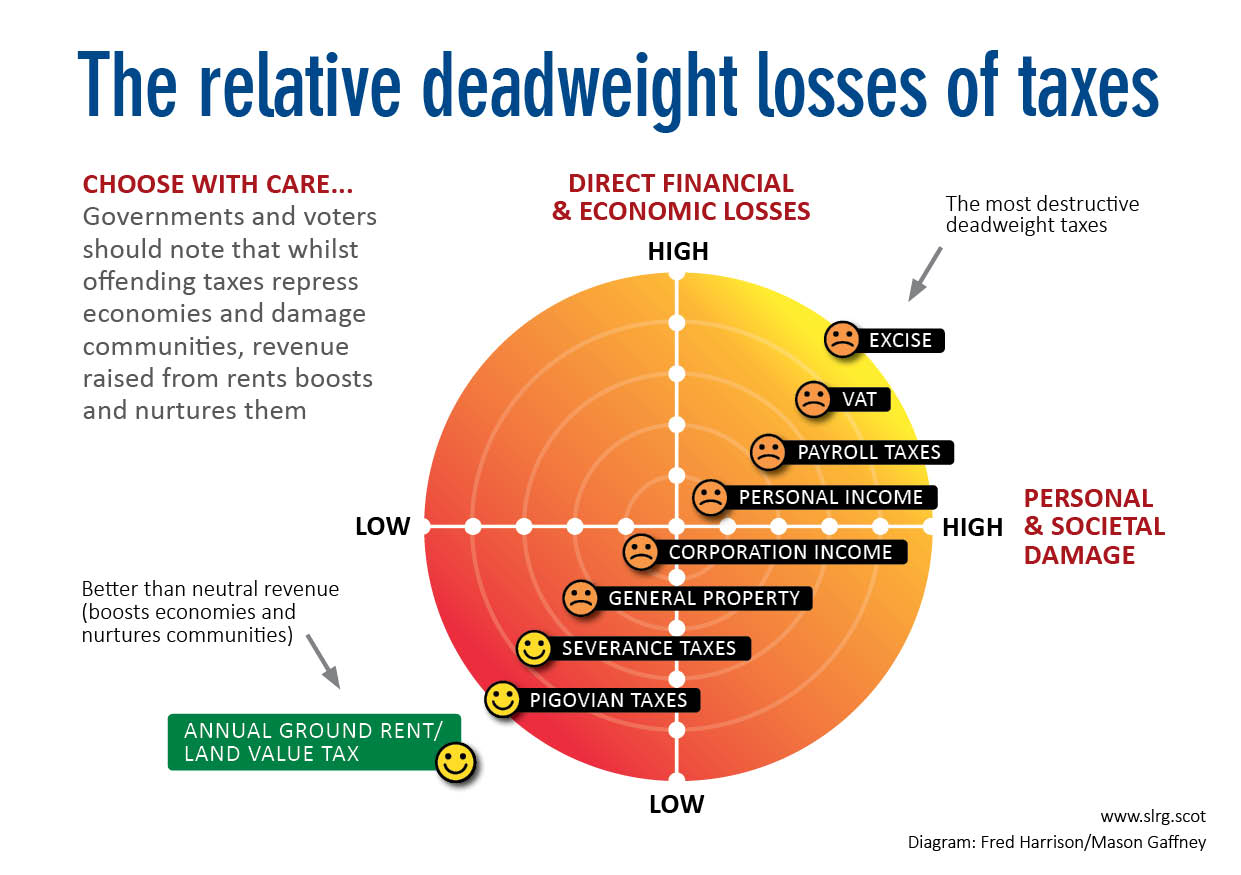
22. August 2018 · Comments Off on Voters and politicians need to identify ‘Deadweight Losses’ · Categories: AGR

Whether you are a politician or a voter, do you know what the deadweight losses of tax are?

If not, you cannot start to sort Scotland’s economic and social problems.

That is because the damage inflicted to economies and communities when the wrong taxes are chosen is devastating (currently up to £1 trillion a year in the UK; Scotland up to £72bn). The level of damage, even if it were half as bad as this, is far worse than any worst case scenario that could be inflicted on us by the EU post-Brexit.

Voters need to press their political representatives to move from taxing wages and trade to raising revenue from the rents produced by society itself, or which are provided free by nature. Only then can the enterprises needed to empower communities across Scotland be free to add maximum (shared) wealth to our country.

AGR/LVT please!

15. August 2018 · Comments Off on Must Holyrood rubber stamp the Westminster-designed tax claw-back scam at the heart of UK inequality? · Categories: AGR

The operation of the UK government tax scam, by which capital gains from high value locations rapidly offset, then overtake, the entire lifetime tax liabilities of site (home) owners, is documented in Fred Harrison’s book, Ricardo’s Law.

The unearned wealth extracted by site owners is produced by society as a whole when it invests people’s taxes in amenities.

This travesty, of course, leaves the full costs of state to be borne by others less fortunate. And explains the ‘necessity’ for government-applied Austerity.

Must Holyrood approve and perpetuate such Westminster cons? So far, the Scottish Parliament has exhibited little awareness of the culpability being transferred onto its shoulders from Westminster.

Take, for example, devolved Income Tax. Will the Scottish Government tell us how much Scotland loses each year from the deadweight losses of Income Tax, a tax it now independently champions in Scotland for the first time?

£12 billion (Harrison)? £24 billion (Feldstein)? Or even more?

AGR/LVT please (zero deadweight losses)!

https://shepheard-walwyn.co.uk/product/ricardos-law/

14. August 2018 · Comments Off on A meaningful referendum · Categories: AGR

A meaningful referendum would be one in which the British people were consulted on whether, after Brexit, they wish to be liberated from the taxes that impose £500bn+ worth of avoidable damage to the wealth and health of the nation (Scotland £36bn+).

The only viable strategy for the UK is a reform-led programme that organically restructures the economy to replace rent-seeking with value-adding enterprise. That is, migrating from taxing wages and trade to AGR/LVT. This would re-balance relationships between the regions by eliminating the economic bias that has favoured London for centuries and continues to do so today.

If Scots embraced such a reform and Westminster resisted the erosion of its traditional unfair London and south-east privileges within the ‘UK Idea’ as currently managed (likely), Scottish independence would be certain and Scotland’s future bright.

With AGR Scotland, on its own, would indeed prosper. Annual deficits would be history. The policy of indebting our children before they are born would be binned.

As a full partner (not a status achieved to date) in a reformed AGR-UK, Scotland would prosper even more. But whether Westminster can adapt in the face of pressure from vested interests at the roots of UK inequality is doubtful. In which case Scotland must move to AGR/LVT alone.

Holyrood can start today by using existing devolved tax varying powers to swap a large chunk of Income Tax (or indeed all of it) for locally collected AGR/LVT. Even this first step would radically transform the lives of Scots for the better. Powers to eliminate the other two thirds of the economic damage (attributable in the main to VAT and National Insurance) are yet to be won.

11. August 2018 · Comments Off on New SLRG publication from Fred Harrison and Ian Kirkwood outlines the post-Brexit opportunity for shared Scottish prosperity · Categories: AGR

In this SLRG pamphlet the authors describe the post-Brexit era as the first realistic chance since 1945 for all of the political parties to unite behind the one financial reform that would forge a new start for the United Kingdom. That is, the migration from a system of taxation which represses production by at least £500bn a year to Annual Ground Rent (aka Land Value Tax).

Read the pamphlet here Blitz or £500bn.web.

Scotland after Brexit can flourish as never before. Over the past 300 years, the peoples of the four nations laboured under a tax regime which imposed an artificial ceiling on productivity.

Those taxes continue to create havoc in people’s lives. The only viable strategy for the UK is a fiscal reform-led programme that organically restructures the economy to replace rent-seeking with value-adding enterprise. This would re-balance relationships between the regions by eliminating the bias that now favours London. And it would transform the City of London to secure prosperity across the kingdom.

A national conversation is needed to create the democratic mandate that authorises the re-design of the public’s finances. And the leaders of all political parties must agree to work together to eliminate the internal barriers that rupture people’s health and wealth.

The annual UK damage caused by the tax regime amounts to at least £500bn. The palliative policies that are supposed to mitigate that damage have failed.

Twice in the 20th century the people of Britain mandated the structural reform of their finances. Twice the law was enacted. Twice, Parliament failed to honour the “rule of law”. Will Holyrood and Westminster now grasp the opportunity offered by Brexit to bring our nations a new kind of prosperity?